
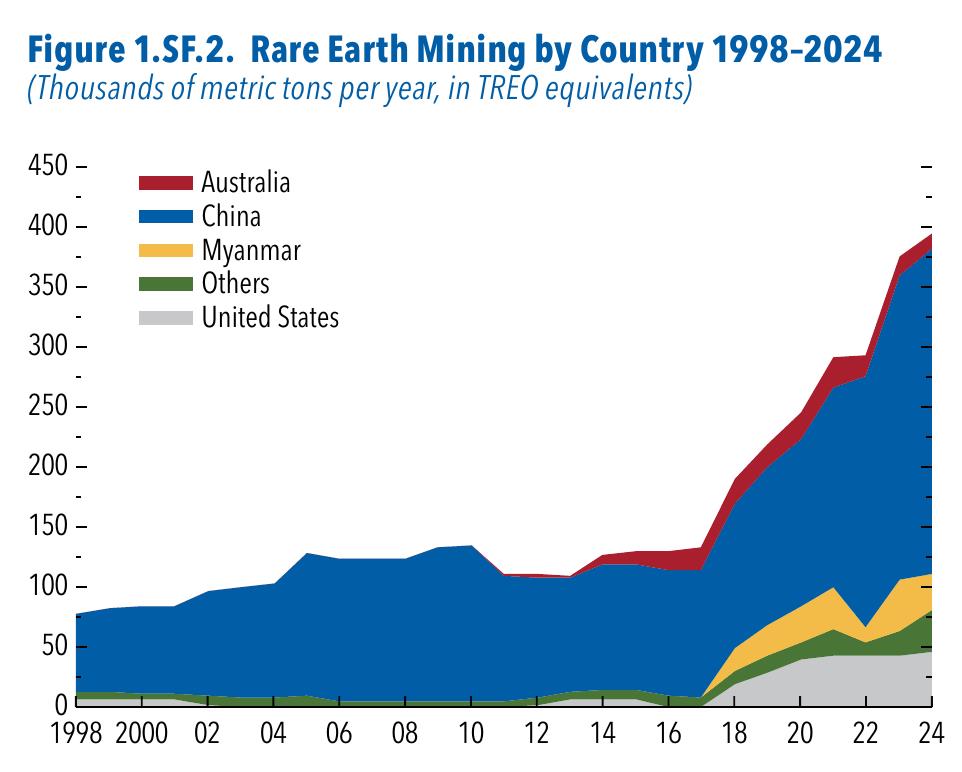
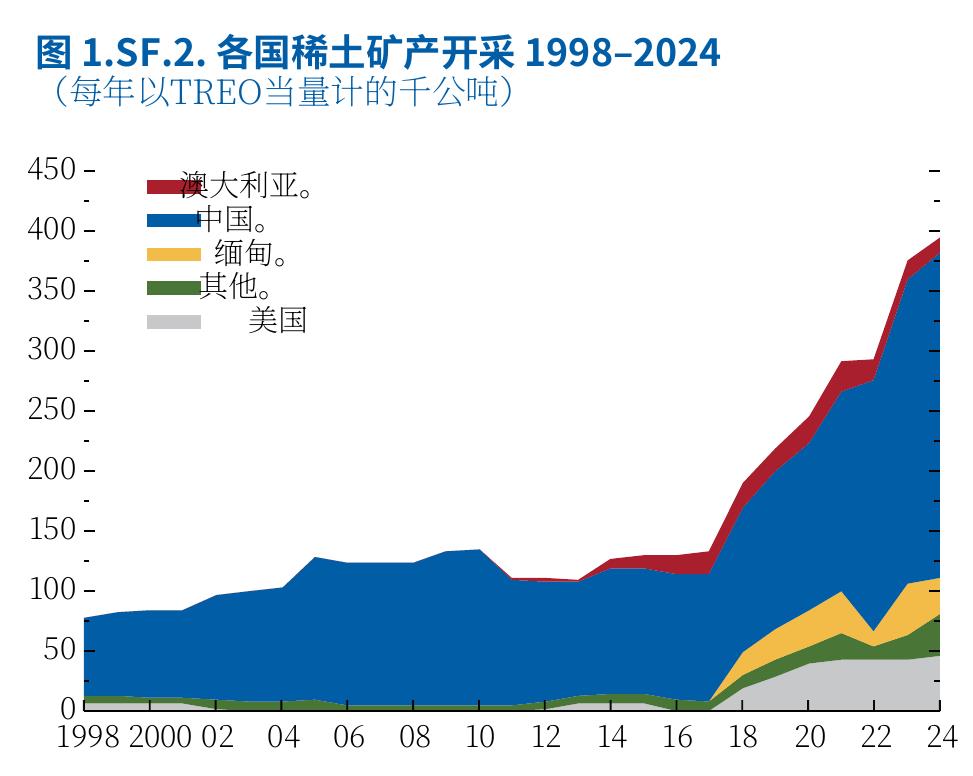
increasingly urgent. This Special Feature addresses two tries? and (2) What would it cost to sufficiently de-risk the REE supply chain over the next decade? REEs are a group of 17 chemically similar metals, earth elements (HREEs), substantially less abundant in the earth's crust than LREEs. REEs possess unique make them valuable inputs across electronic, magnetic, optical, and catalytic applications. They are used Survey, "'Rare Earths Statistics and Information"; and IMF staff calculations. manufacturing (especially electric vehicles), renewable energy, oil refineries, defense systems, semiconductors, and consumer electronics. Arguably the single most specialized stages: mining, concentration, separation extraction, and refining to metals or alloys. The maintains its properties at elevated temperatures. These downstream manufacturers, including permanent magnet producers. The separation stage is particularly (or vice versa), making them central to both the clean technically demanding, requiring hundreds of sequen- energy transition and advanced manufacturing. tial processing steps, and it is also a pollution-intensive market, with rare earth oxides (REOs) valued at about billions in capital investment, years of regulatory $25 billion in 2024 (Market Data Forecast 2025). As such, the economics of rare earths are increasingly Technical expertise acquired over decades, estab- and dysprosium. These “magnet-4” elements jointly lished infrastructure, differences in environmental and labor regulations, and subsidies made China the dominant world producer of REEs during the 2000s. Today, China's dominance varies significantly by rare earth type and supply chain stage. In regard to LREEs, oxides (REOs) contained in mined material. It provides a consistent measure for comparing rare earth output across mines, deposits, and ity and 93 percent of its metal refining. With respect for permanent magnets—the largest and fastest-growing application, to HREEs, China retains a near monopoly across composition of rare earth deposits, which yield lower-demand the higher-demand magnet elements neodymium, praseodymium, panel 2), 97 percent of oxide separation, 95 percent of





 原图定位
原图定位