图2.20:. Impact on Value Added of ASEAN+3 (excl. China) due to a 10-percent China or US Final Demand Shock in 2000 and 2024

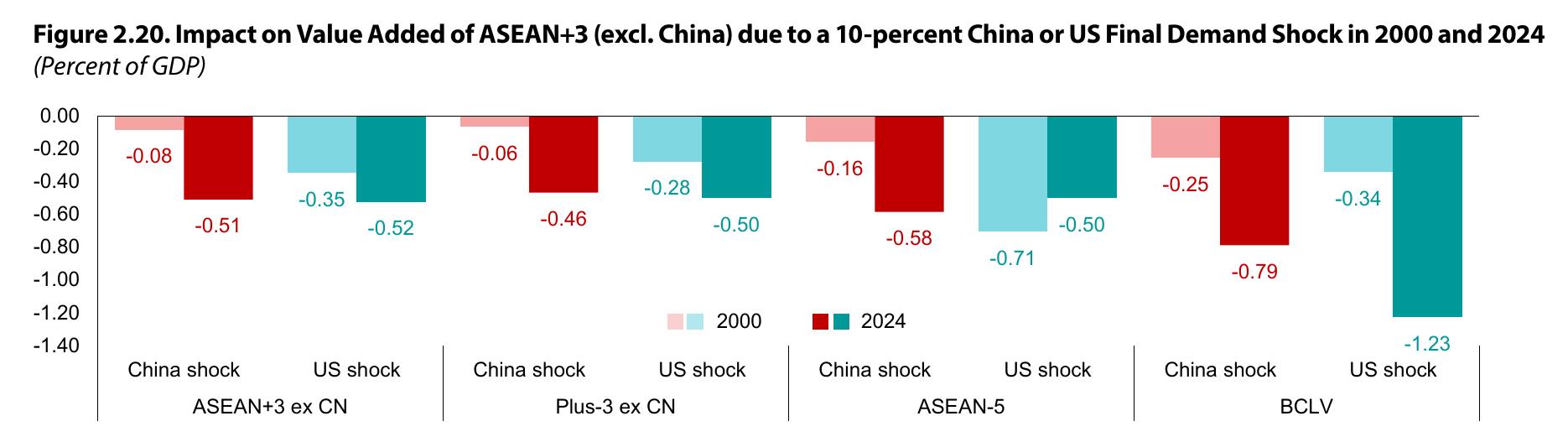
Chapter 2. A More Regionally Anchored ASEAN+3: The Transformation of Economic Linkages with China specifically, the estimated coefficients full-sample estimates, indicating that China-anchored panel).12 The importance of regional factors rose steadily, and by 2016-2024, excluding crisis years, regional factors increased. This is consistent with literature linking trade became particularly pronounced after 2016, coinciding synchronization (Frankel and Rose 1998; Calderon and others 2007; Kose and others 2012). Overall, this finding and associated supply chain reconfigurations. The pattern contrasts with other regions globally, where the of regional synchronization. The next question is what (Kose and others 2012; IMF 2013). Nevertheless, global cycle, especially during periods of global crises such as COVID-19 and the subsequent supply chain disruptions. shifted as production networks deepened. Supply chain integration, via deeper GVC and FDI In tandem with increased regional synchronization, linkages, is significantly associated with the increased business cycle synchronization in the region. Regression to extraregional ones since 2000. Input-output ASEAN+3 by approximately 0.5 percent, based on 2024 ASEAN+3 economies.13 When examining correlations Source: World Bank; AMRO staff calculations. mposed into shares explained by global factor, regional StatesbaedonthMTaln0ighearreentmulatedmactin000darearpresent ilatdacti20eelinenx6f methodology.



 原图定位
原图定位