
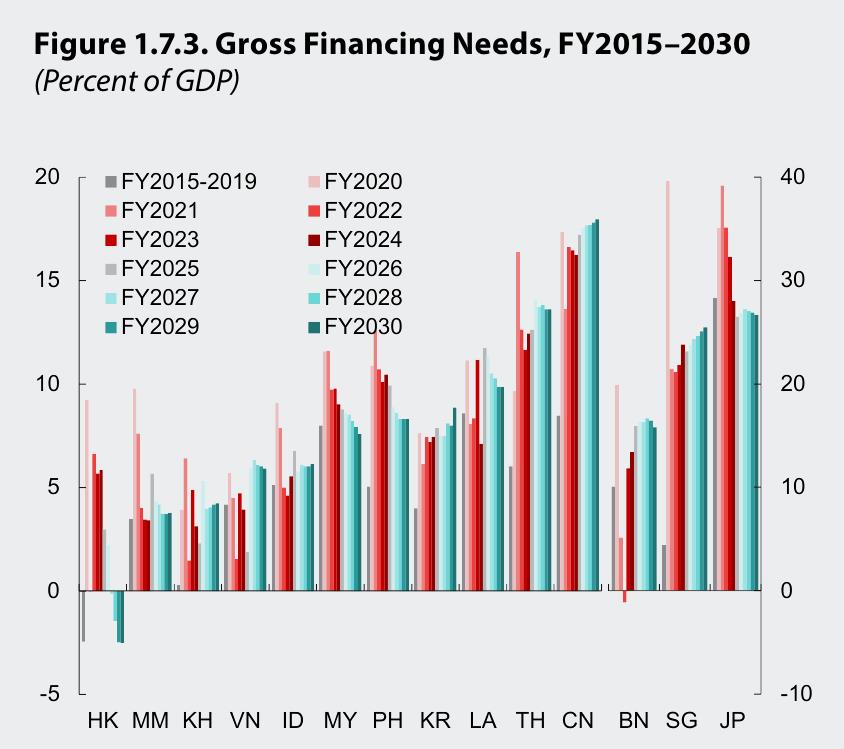
Chapter 1. Macroeconomic Prospects and Challenges Gross financing needs (GFN) also remains elevated, challenging operating environment, establishing credible fiscal anchor - supported by clear, increased in seven member economies in FY2025, driven consistently applied rules that are simple, flexible, mainly by larger primary deficits in Brunei, Myanmar, and Thailand, and by rising amortization requirements sustainability. Strategic resource allocation under amortization needs in Lao PDR surged, reflecting the national priorities, emphasizing inclusive growth and investments in infrastructure, education, and short-term borrowing in FY2024. In contrast, the GFN climate change. Effective fiscal management ratio declined in seven economies in FY2025, supported also depends on improving spending efficiency, by narrower primary deficits in Hong Kong, Japan, and Malaysia, and by stronger economic growth, enhancing expanding the tax base through digitalization, debt-servicing capacity. Looking ahead, despite a and rigorously managing tax expenditures, stabiliing or declining government debt-to-GDP ratio, and transparent oversight of contingent liabilities, state-owned enterprises, and social insurance over the medium term in most member economies. The interest burden is also projected to remain high, reflecting the effect of accumulated debt stock, despite the gradual stabilization of sovereign yields. , and gfn=gross fnancing needs as a percentage of GDP, PD=primary deficit, IP=interest payment, PP=principal payment, P=GDP delator, Y=real GDP, g=real GDP growth, π=GDP deflatorinflation.





![满足AI推理需求所需的计算资源规模(以吉瓦计)[9]](https://file.sgpjbg.com/FileUpload1/News/2a923cfb-8dea-43d4-9114-4097f1972f49.png "满足AI推理需求所需的计算资源规模(以吉瓦计)[9]")

 原图定位
原图定位