
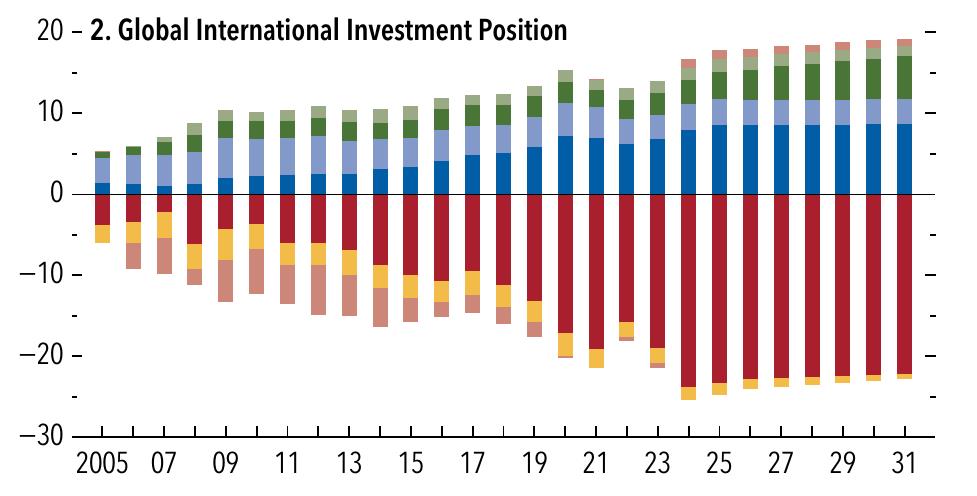
1.0 - 2. Variations Explained by Country-Specific Factors Sources: Haver Analytics; and IMF staff calculations. Note: Panel 1 shows the average inflation across 27 countries for which data are available. All numbers are simple averages. Panel 2 shows the share of country-level component ofinflation across 27 countries, computed in a rolling two-year window. el'ein pueu 'ewuaa'uniag 'snn ane ,sioan ueadon, aon area, headline inflation is projected to increase tem- Luxembourg, The Netherlands, Norway, Slovenia, Sweden, and Switzerland."European debtors" are Cyprus, Greece,lreland, Portugal, and Spain."Oil exporters" are Algeria, Azerbaijan,lran, Kazakhstan, Kuwait, Nigeria, Oman, Qatar, Russia, Saudi Arabia, United Arab Emirates, and Venezuela. target in 2027. Core inflation is expected to increase levels, whereas inflation in India is expected to return Over the medium term, global imbalances are business investment surge, which is expected to con- from 5.1 percent in 2025 to 2.8 percent in 2026 and as investment in technology moderates. Stronger pro- chains as time goes by. Exports of both goods and ser- and improve the country's trade balance. But positive over the forecast horizon, with the decline in services wealth effects that boost domestic demand, together trade being much less pronounced. This reflects the with sustained capital inflows driven by higher returns,



![满足AI推理需求所需的计算资源规模(以吉瓦计)[9]](https://file.sgpjbg.com/FileUpload1/News/2a923cfb-8dea-43d4-9114-4097f1972f49.png "满足AI推理需求所需的计算资源规模(以吉瓦计)[9]")

 原图定位
原图定位