San Francisco: $10.2 billion in H1 2025

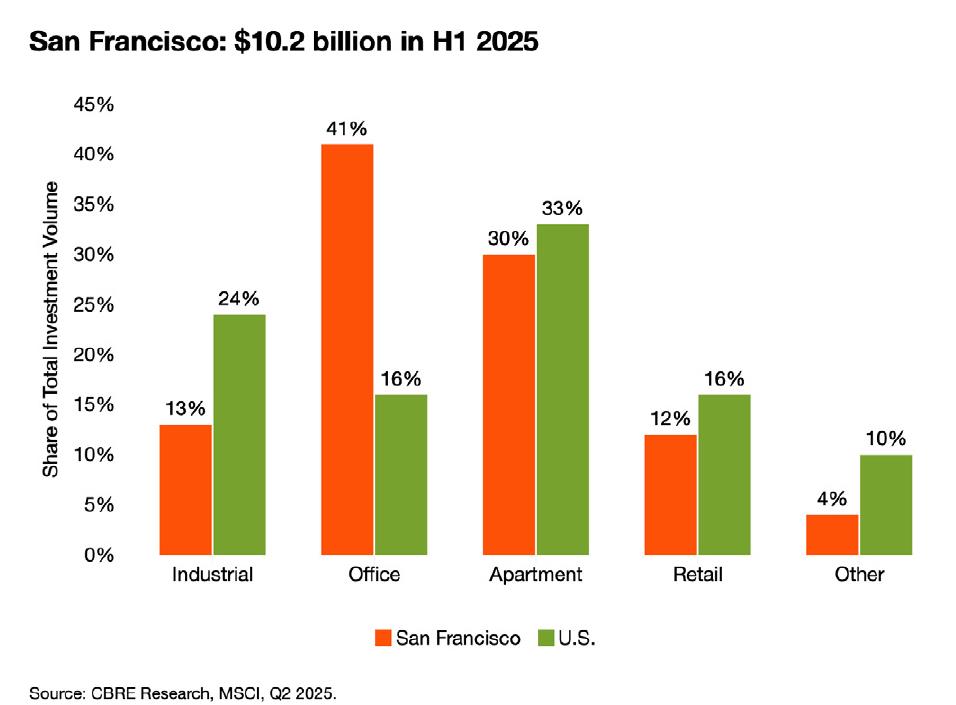
Growth of the artificial intelligence (Al) industry, along with more workers returning to the office, has begun to lower Valley region. Net absorption was firmly positive in the first half of 2025 as more workers returned to the office, 14 percent as of midyear 2025, while prime buildings had a 25 percent rate and non-prime buildings a 43 percent rate. Similarly, average rent for space in trophy buildings is 7 percent above pre-pandemic levels, while that for non-prime demand and falling supply. Al-related companies have since 2024 and now occupy 6.3 million square feet of office hub, supported by Stanford University and the University of California, San Francisco. As Al begins to transform the health care sector, life sciences companies are well- Francisco's Financial District and Mission Bay, where rising As companies scale and seek collaborative environments, in urban centers that offer proximity to talent, infrastructure, and institutional capital. Housing demand will also grow as Looking ahead, the Bay Area is set to lead the next wave opportunities. Al and other advanced technologies are talent, capital, and institutional strength will drive sustained office vacancy rate, much of this space does not meet the needs of tenants currently in the market. Many occupiers modern, move-in-ready space that does not require costly, 97 Emerging Trends in Real Estate? 2026


 原图定位
原图定位