
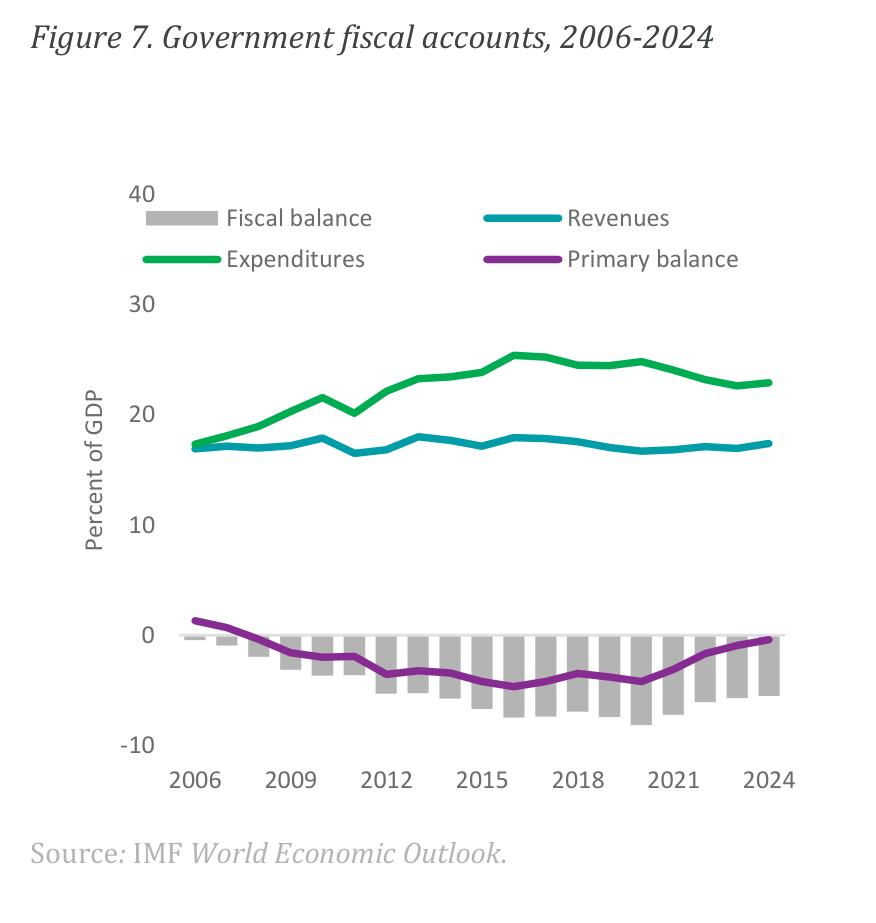
Large government-led investment programs, increased spending in the context of devolution, and limited revenue collection drove large increases in public debt. However, the sharp increase in public investment in infrastructure, in addition to higher spending to enhance public service delivery at the subnational level, led to a growing gap between government expenditures and revenues. The fiscal deficit grew steadily throughout the 2010s, as overall expenditure drifted higher while revenue remained mostly constant as a share of investment, peaking at over seven percent of GDP in 2016/17 when the Mombasa-Nairobi Standard government, with 47 county-level governments, also increased recurrent expenditures. Kenya's public debt burden grew sharply as a result. The stock of debt increased to 73.2 percent by end-of-2023, from 35.7 percent of GDP in 2011. Spending on interest more than doubled as a share of government revenue over the past decade as well, being more expensive than the average country where capital inflows were looking for higher yields in developing markets. As the government attempted an ambitious reform effort to reduce high fiscal deficits, it was met with public backlash in the context of the Finance Bill 2024.


 原图定位
原图定位