
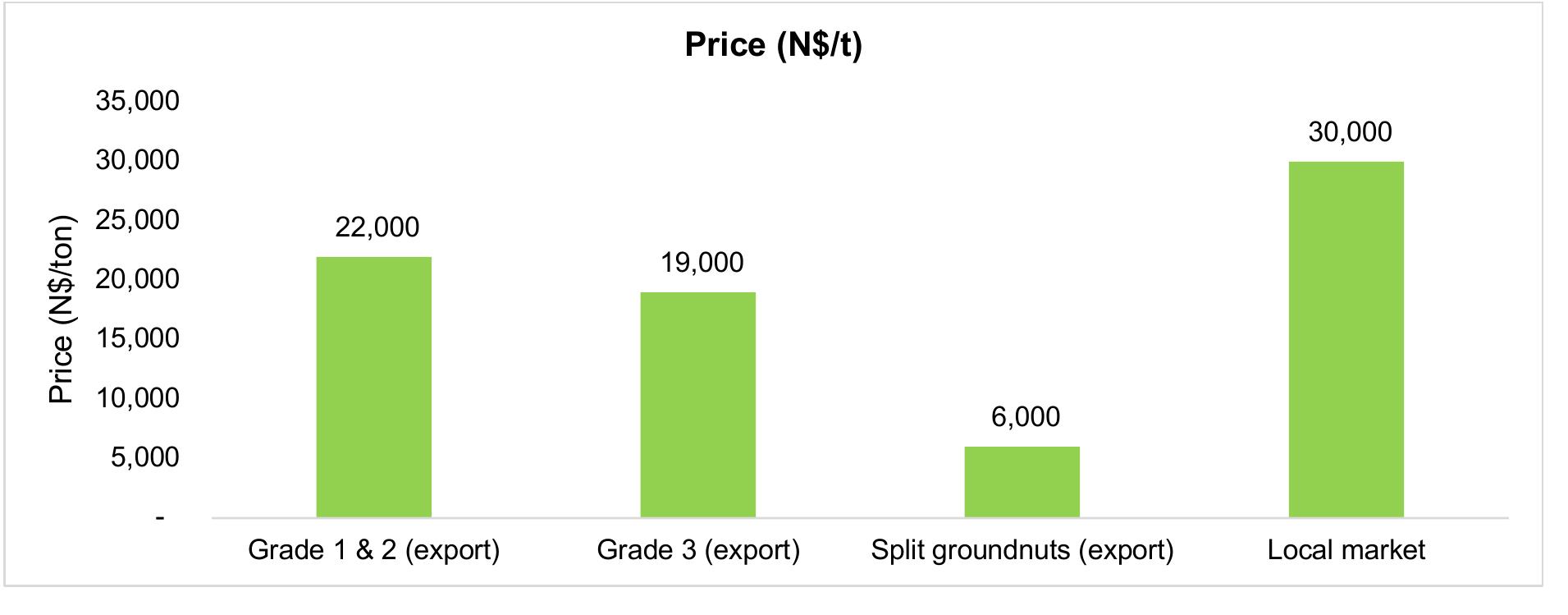
reflecting how market structure influences producer incomes. The findings indicate that export markets, while offering higher prices, particularly for premium grades, are less accessible to most producers due to quality standards, grading requirements, and logistical constraints. On the other hand, informal markets such as open markets and street vendors offer lower prices but greater flexibility, providing farmers with immediate cash income and reduced transaction costs. The price difference across grades at the export level, ranging from N$6,0oo.o0/t for split groundnuts to N$22,000.00/t for Grade 1 and 2, highlights the importance of quality differentiation and grading systems in determining market value. Locally, the estimated N$30,000.00/t equivalent suggests that small-scale packaging and direct sales to consumers may yield higher unit prices, albeit at lower trade agricultural products into processed goods (Dos-Santos, 2020). Through activities such as shelling, roasting, oil extraction, peanut butter production, and packaging, farmers can tap into higher-value markets, extend product shelf life, and reduce post-harvest losses (Kwanza, 2025). Beyond income generation, value addition strengthens rural enterprises, creates employment opportunities, and supports the development of resilient agri-food systems (De Brauw & Bulte, 2021).



 原图定位
原图定位