
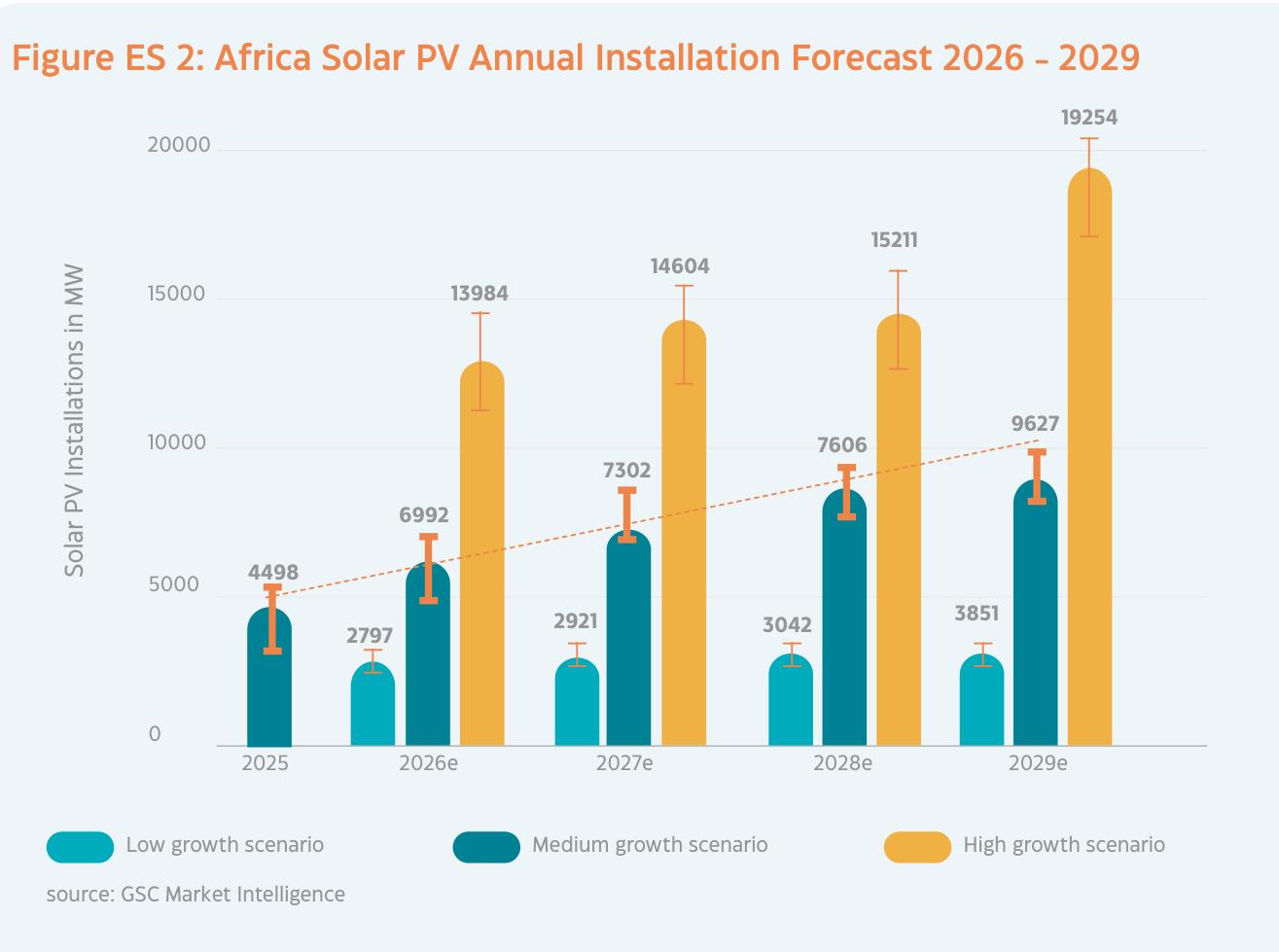
(120 MW), Ghana (92 MW) and Chad (86 MW) - each added substantial new capacity in 2025, reinforcing a trend toward broader market participation. Africa's renewable energy transition is accelerating, supported by strong economic momentum, In 2025, close to 8 countries have installed 100Mw or above, against 4 last year, essentially falling technology costs, and rising demand for reliable power. With economic growth reaching doubling the number of countries. Additionally, two countries were closing in on this threshold around 3.9% in 2025 and more than 20 countries exceeding 5% growth, energy supply has (Ghana and Chad). This confirms the trend of diversification identified in last year's report. renewable expansion, including a continental target of 300 GW by 2030 and initiatives such as Looking ahead, the report's medium-term outlook suggests Africa could install over 31.5 GW of Mission 300 to connect 300 million people. Solar sits at the core of this trajectory, positioning the solar capacity by 2029, as distributed and utility-scale markets continue to expand in parallel technology as both an energy access solution and an engine for competitiveness and resilience. Africa's solar market is entering a new phase. While utility-scale has accounted for 56% of the in 2025, the top 10 solar markets accounted for around 90% of new solar capacity additions, led installed capacity in 2025, it is important to note that the distributed capacity (44%) is clearly underestimated, as it is harder to track. Growth has traditionally been led by utility-scale projects, continued strength in large, established markets; at the same time, several mid-sized and


 原图定位
原图定位